Field note · 18 May 2026
Reading a khlong bank before the rains
A dry-season photograph of a Bangkok bank is a polite lie if you treat the grass line as the water line. The plate we draw in May is a band, and the width of that band is the point.
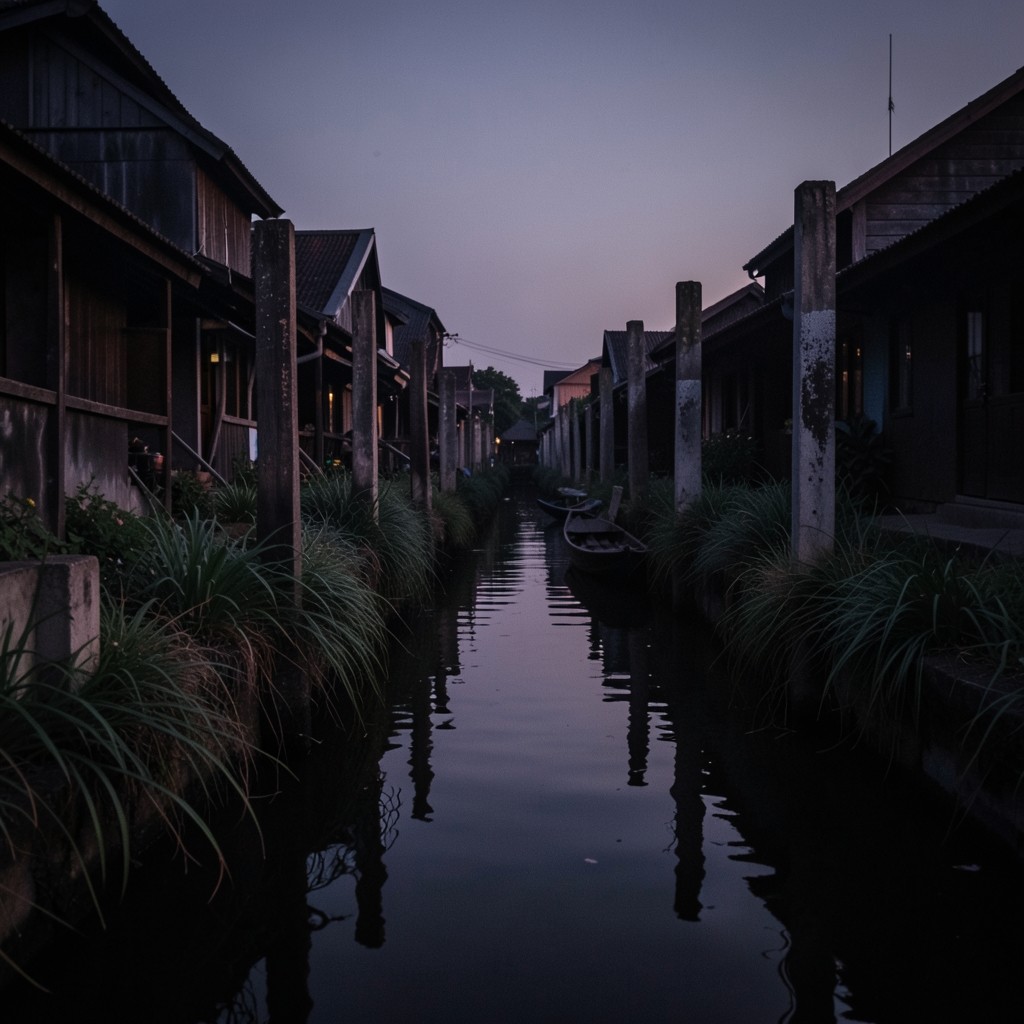
Clients often ask for the water line, as if a khlong kept one. On the banks we walk from Tha Raeng toward Min Buri, the useful record is a stack of marks from different years, some of them half scrubbed off. A place study or a canal reading that collapses those marks into a neat stroke is easier to glance at and worse to build beside.
What May still shows
Before the rains settle in, Malee looks for four things and writes them in that order. First, stain on concrete posts and on the brick of older fences: a tea-colored band, often sharper on the side that faces the water. Second, debris caught in branches or in the wire of a fence, which tells you a height the water reached while carrying rubbish, not the height it reached in a clean rise. Third, grass or vines laid in one direction and only partly stood back up. Fourth, the opposite bank: if it is lower, your side’s dramatic story may be ordinary on the other side, and the plate has to show both.
She does not start with the neighbor’s memory. Memory comes after the marks, and it is kept in a separate column of the finding. People remember the year the lane flooded and forget the year the water only kissed the third step. Both can be true to the person speaking. They are not the same evidence as a stain.
The repainted post
Last August, on a bank off Lat Phrao, three posts agreed with each other within a hand’s width. A fourth had been painted a fresh grey and showed nothing. A desk drawing that averaged the four would have lowered the band to flatter the new paint. The plate left the fourth post off the water evidence and noted the paint in the caption. The client was briefly annoyed. The community meeting later used the caption, because someone in the room had watched the painting happen.
A band, not a prophecy
The sheet that leaves the studio draws a band: the lowest mark we trust, the highest mark we trust, and a hatched gap where the evidence fights itself. That is data visualization in the plain sense — measurements and refusals put where a person can see them together. It is not a forecast. Pumps, a blocked culvert, a new fill on the next parcel: any of these can move next year’s water without asking our plate for permission.
If you are deciding a floor level, the band is the part to take to your architect, and the architect’s drawing is a different document. If you need a single official line for a permit, you need the office that issues that line. Our May walk is for the conversation that happens before either of those.